Type, Example sentences, Examples of exercises, short notes
June 14, 2025

In Malay language learning, personal pronouns are one of the important components of grammar.
It is used to replace the names of people, animals, things or things to avoid repetition.
Mastery of personal pronouns can help writing and speech become more neat, clear and effective.
By mastering its use, a student is able to convey the message more effectively and structured.
What is a pronoun name?
Self -pronoun is a word used to replace a person’s name or thing.
Its use makes the sentences simpler and non-repetitive, thus increasing the smoothness of writing and speech.
Examples like me, you, them, us and so on. Its use depends on the situation, the number, and the relationship between the speaker and the so -called person.
In Malay, personal pronouns are divided into several main types, each with its own function and use.
The type and example of a sentence
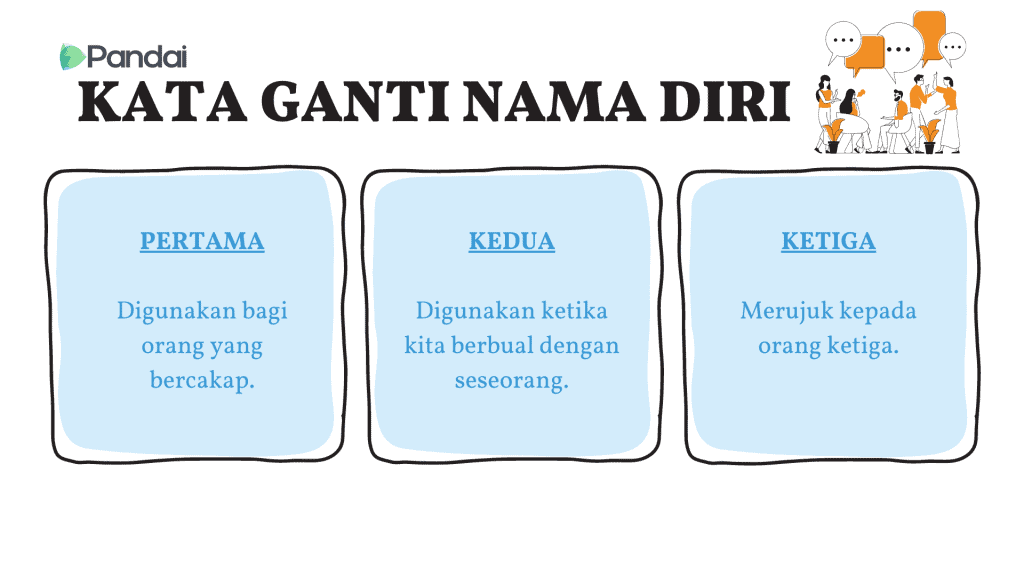
In general, this type of pronoun can be divided into four main types:
1. First Self Name pronouns
Refer to the person who speaks or the author.
Used when a person refers to himself or the group he represents.
Example:
- Me: Used in general or official situations.
- I: Used in unofficial situations or between close friends.
- We: Refers to “me and others” but does not include people who hear or speak.
- We: Refers to “me and others” including people who hear or speak.
- Tattooed: Used by ordinary people when talking to a king or dignity.
- Slave: Used in ancient times to refer to yourself, it is rarely used.
Example sentences:
- I will go to the library after the class is over.
- I Can’t wait to go back to his hometown.
- We The family will be on vacation to Langkawi Island next week.
- Mari We Together we clean this school area.
- seal uphold the grace of my grace.
2. The second name pronouns
Referring to the person being talked about or the reader.
Used when someone refers to an individual or group that is a listener or recipient of the message.
Example:
- You: Used in unofficial situations.
- You: Used in formal or general situations, especially when referring to strangers or large groups.
- You: Used in very informal situations, usually between close friends or to younger people.
- You: Used to refer to more than one.
- Your Majesty: Used when talking to the king or dignitaries.
- You guys: Used to refer to more than one.
Example sentences:
- You Have you had breakfast?
- You Invited to attend the dinner.
- “Where are you Want to go? ” Ask her son’s mother.
- You Everyone needs to complete this assignment before tomorrow.
- “How are you, My lord? ” Worshiping.
3. Third Self Name pronouns
Refers to the person or thing that is said.
Used when a person refers to an individual or object that is not present in a conversation or previously mentioned.
Example:
- Is: Used to refer to an individual.
- Ia: Used to refer to humans or animals or things.
- He: Used to refer to respected people such as teachers, doctors, ministers, or parents.
- Them: Used to refer to more than one individual.
- His Majesty: Used to refer to a king or noble person.
Example sentences:
- Is Unable to attend a meeting due to fever.
- Pigeons That flying high in the sky.
- He is a very dedicated doctor.
- Their is training for a basketball competition.
- His Majesty has forgiven the offender.
4. The pronoun pronouns
Refers to something shown, whether place, thing, or time.
Example:
- That: Used to show something far away.
- This: Used to show something close.
Example sentences:
- Book This was a gift from my friend.
- House That It’s more than 100 years old.
- Please put the bag This on the table.
- Who lives at home That?
- I like to see the beautiful scenery on the spot This.
Self -name pronoun exercise
By understanding the type and use of the correct pronouns, you can produce more accurate, concise, and effective sentences in daily communication.
Ongoing training will help you master the use better.
A brief note


Credit: Smart.org
- “Your Majesty” And “Seal” is a royal pronoun used in the context of the palace.
- Select the pronoun the name of the self in accordance with the context of a sentence And The relationship between speakers and listeners.
- Consumption “He” specifically for respected people. Avoid using it to refer to animals or things.
- “We” excludes the listener, while “We” include people who listen.
- “Ia” can refer to humans, animals, or things, but “Is” is “ only for humans.
Gaming
Berita Olahraga
News
Berita Terkini
Berita Terbaru
Berita Teknologi
Seputar Teknologi
Drama Korea
Resep Masakan
Pendidikan
Berita Terbaru
Berita Terbaru
Berita Terbaru
Lifestyle