Malaysia’s Latest Diesel Prices (16-22 April 2026)
April 15, 2026
Latest diesel prices in Malaysia and ASEAN countries show a significant upward trend, influenced by global factors, subsidies and high demand in the economic sector.
Price differences between countries are also becoming more apparent, reflecting government policies and dependence on the international market.
This article will compare the latest diesel prices and explain the main reasons for their increase.
Ministry of Energy & Natural Resources
Latest Oil Prices
Loading…
Diesel Prices in Malaysia This Week (16-22 April 2026)
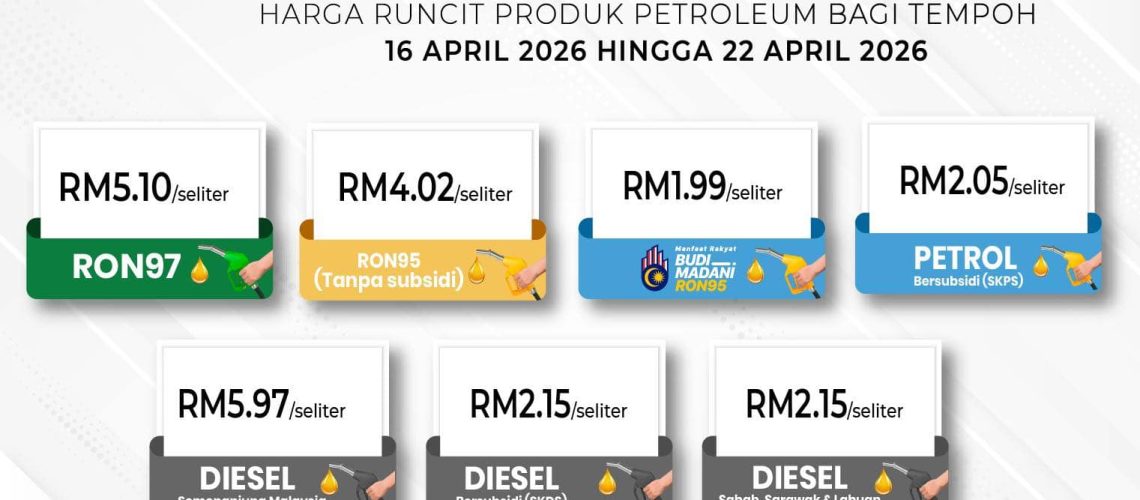
Along with the drop in world oil market prices, the Government lowered the price of fuel other than RON95 BUDI MADANI in Peninsular Malaysia for the period from April 16, 2026 to April 22, 2026:
- RON97 DOWN 25 cents at → RM5.10 per litre
- RON95 without subsidy DOWN 25sen at → RM4.02 per litre
- Subsidized RON95 (BUDI95) REMAINS at RM1.99 per liter
- Peninsular Malaysia Diesel DOWN 75sen at → RM5.97 per litre
- Sabah, Sarawak & Labuan diesel REMAINS at RM2.15 per litre

Diesel Prices in ASEAN Countries
The latest diesel prices in ASEAN countries show significant increases as well as large differences between countries. Based on the data so far 9 April 2026this price gap is influenced by factors such as government subsidies, import costs and global market pressure.
Countries that are less subsidized or dependent on imports tend to record higher prices.
| Country | Diesel Price (RM) |
|---|---|
| Malaysia | 2.15 (subsidized) / 6.72 (without subsidy) |
| Indonesia | 1.62 (subsidies) |
| Brunei | 0.96 |
| Vietnam | 6.48 |
| Thailand | 6.00 |
| Filipina | 6.21 – 6.67 |
| Cambodia | 8.16 |
| Timor-Leste | 7.76 |
| Laos | 9.32 |
| Myanmar | 10.78 |
| Singapore | 14.44 – 14.63 |
Overall, Malaysia and Indonesia diesel prices are still low due to government subsidies that help control costs.
However, without subsidies, the real price of diesel can skyrocket as shown in Malaysia.
Countries like Singapore, Myanmar and Laos record the highest prices due to lack of subsidy control and high exposure to global market prices. This shows that diesel is very sensitive to world supply disruptions.
Why are diesel prices rising higher than petrol?
Diesel prices are often higher due to its large role in the global economy and more complex supply and demand factors.
1. Global Market
Diesel is an international trade fuel used by ships, trucks and trains. Therefore, any global disruptions such as conflicts or blockades can cause prices to rise around the world.
2. Demand is High & Difficult to Reduce
Unlike gasoline, diesel is used in important sectors such as logistics, agriculture, construction and industry. This activity cannot be stopped even if the price rises, causing demand to remain high.
3. No Easy Alternative
Goods still need to be delivered, crops need to be cultivated and projects need to continue. The lack of alternatives makes demand for diesel less flexible.
4. Limited Production
Diesel and gasoline are produced from different parts of crude oil. Refineries cannot increase diesel production quickly, especially when operating near maximum capacity.
5. Seasonal Factors
In certain seasons such as winter or planting season, the demand for diesel increases. This adds pressure to existing supplies.
6. Great Impact on the Economy
Diesel drives the goods transport system. When the price goes up, the logistics cost goes up and eventually causes the price of goods to go up as well.
Why are subsidized diesel prices cheaper in Sabah & Sarawak?
Factors maintaining the diesel subsidy in Sabah and Sarawak are:
- Different geographical structures –
- The interior area is wide
- The terrain is challenging
- Scattered placement
- Access to the road network becomes limited
- High dependence on water transport & heavy vehicles
- Infrastructure challenges
- The coverage of lifting & energy infrastructure is still uneven, especially in rural and rural areas
- Lack of stable access to grid electricity & modern logistics systems make diesel the main source of energy
- High logistics costs
- Shipping goods need to travel long distances by sea & river
- Includes layered transportation costs
- Any increase in fuel prices has a direct impact on distribution costs
- The level of the local economy is lower
- The average income in the rural areas of Sabah & Sarawak is still lower than in the Peninsula
- Without subsidies, price increases risk suppressing the cost of living & affecting the well-being of the population
- Dependence on generators & diesel based economic activities
- Diesel is widely used for electricity generation in areas that are not connected to the national grid such as in economic sectors such as:
- boat operations for fishing activities
- river and sea transport
- other rural activities that depend on portable energy supply
- Diesel is widely used for electricity generation in areas that are not connected to the national grid such as in economic sectors such as:
How to Lighten the Burden of Diesel Price Increase
The rise in diesel prices has a big impact on people and businesses. Therefore, the government takes a targeted approach to ensure aid reaches the needy, while controlling the country’s financial burden.
1. Targeted Cash Assistance
The government replaced the blanket subsidy with direct cash assistance to the deserving. This help too increased from RM200 to RM300to help cover the rising cost of diesel.
2. Gradual Subsidy Reduction
Subsidies are no longer given in bulk to all consumers. This approach is fairer because only certain groups receive benefits, thus reducing waste.
3. Implementation of Diesel Quota (Example 200 Liters)
The government introduced usage limits such as kuota 200 liters to reduce the risk of subsidy leakage and ensure more controlled use.
4. Price Control for Certain Groups
Although global prices are rising, the government still provides lower prices through certain schemes, for example around RM1.99 per literto protect affected users.
5. Reduce Subsidy Leakage
A targeted approach helps ensure that subsidies are not enjoyed by ineligible parties, thus increasing the efficiency of government spending.
6. Take Global Factors into Account
The rise in diesel stems from the world market, so the government is focused on mitigating the impact through aid and domestic policies.
Diesel Grades & Their Uses
Diesel is a petroleum-based fuel widely used in the transport and industrial sectors for diesel engines.
It works a compression process, where the fuel ignites itself without a spark like a gasoline engine.
Diesel is produced from crude oil and consists of hydrocarbons. It has to comply with certain standards such as cetane rating (determining combustion efficiency) and low sulfur content (ULSD) to reduce pollution.
There are two main grades of diesel:
- Diesel #1: High cetane, low viscosity, suitable for cold weather.
- Diesel #2: Most commonly used, balanced in terms of performance and efficiency.
Also read: Latest Petrol Diesel Prices RON95 RON97 (9-15 April 2026)
Diesel has a variety of important uses and is a key component of the economy. Almost all businesses depend directly or indirectly on diesel for daily operations. It is used to power the engines of trucks, trains and ships that transport various goods.
In addition, most vehicles in the construction and agricultural sectors, including public buses and school buses, also use diesel engines.
Other uses of diesel include:
- Heavy vehicles: Driving lorry engines, public buses, school buses, trucks, trains and ships that transport various goods.
- Military vehicles: Diesel is used in tanks and military trucks because it is less flammable and more stable than other fuels, besides diesel engines are less prone to damage or stalling.
- generator: Used to generate electricity, mainly as a backup power supply in hospitals, large buildings and industrial facilities. In remote areas, diesel generators become the main source of energy.
- Heavy equipment: Machines in the construction and agricultural sectors such as excavators, lifting machinery, and road paving machines mostly use diesel because of its durability.
Frequently Asked Questions About Diesel Price Increase
Diesel prices rose due to global factors such as rising crude oil prices, supply disruptions, as well as high demand in the industrial and transportation sectors.
Diesel is widely used in the economy (logistics, agriculture, industry) and its demand is difficult to reduce, causing its price to rise more easily than gasoline.
People like truck drivers, farmers, contractors and small traders are the most affected as they rely on diesel for daily operations.
Yes, indirectly. The increase in diesel increases the cost of transportation, thus causing the price of goods and food to rise as well.
Differences occur due to factors such as subsidies, taxes, import costs and government policies. Subsidizing countries usually have lower prices.
Subsidies help keep prices lower for certain consumers and reduce the cost-of-living burden.
Subsidized diesel is the government-controlled price, while unsubsidized is the higher true market price.
The government is using targeted approaches such as cash assistance, price controls and consumption quotas to mitigate the impact of the diesel hike.
It depends on the global market conditions. If supply stabilizes and demand decreases, prices can fall again.
Users can reduce consumption, plan trips, and ensure vehicles are well maintained to improve fuel efficiency.
Also read: Oil Prices Rise 8% Following Trump’s Strait of Hormuz Blockade
PakarPBN
A Private Blog Network (PBN) is a collection of websites that are controlled by a single individual or organization and used primarily to build backlinks to a “money site” in order to influence its ranking in search engines such as Google. The core idea behind a PBN is based on the importance of backlinks in Google’s ranking algorithm. Since Google views backlinks as signals of authority and trust, some website owners attempt to artificially create these signals through a controlled network of sites.
In a typical PBN setup, the owner acquires expired or aged domains that already have existing authority, backlinks, and history. These domains are rebuilt with new content and hosted separately, often using different IP addresses, hosting providers, themes, and ownership details to make them appear unrelated. Within the content published on these sites, links are strategically placed that point to the main website the owner wants to rank higher. By doing this, the owner attempts to pass link equity (also known as “link juice”) from the PBN sites to the target website.
The purpose of a PBN is to give the impression that the target website is naturally earning links from multiple independent sources. If done effectively, this can temporarily improve keyword rankings, increase organic visibility, and drive more traffic from search results.