Biodiesel B15 Malaysia 2026: Advantages, Functions and Impact
June 2, 2026
Biodiesel B15 is a new fuel introduced in Malaysia as part of efforts to strengthen the country’s energy supply and support sustainable development.
Its use is expected to benefit the economy, local industry and the environment, in addition to helping reduce dependence on fossil fuels.
Here is everything you need to know about Biodiesel B15 and its importance to Malaysia.
Read more: New MyKad 2026: To be launched in June 2026
What is Biodiesel B15
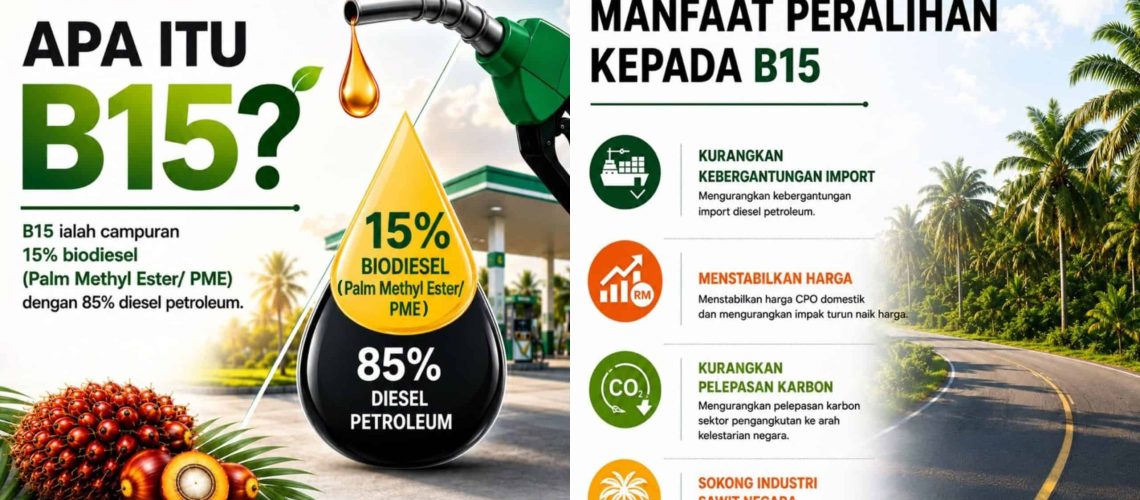
Biodiesel B15 is a diesel fuel produced from a blend 15% palm oil based biodiesel And 85% diesel petroleum.
This mixture is used as an alternative to conventional diesel to promote the use of more sustainable energy sources and reduce dependence on fossil fuels.

Why was Biodiesel B15 Introduced?
The implementation of Biodiesel B15 is done to help the country achieve several important goals in the energy and economic sectors.
Among the main objectives of Biodiesel B15 being introduced are:
- Reduce dependence on fossil fuel imports which is subject to global market price fluctuations.
- Increase the use of local energy resources produced in the country.
- Stabilize the country’s energy supply for the long term.
- Strengthening the country’s energy security through the use of domestic resources.
- Support the sustainable development agenda and Malaysian green energy.
How Biodiesel B15 Supports the Malaysian Oil Palm Industry?
The oil palm industry is one of the most important economic sectors in Malaysia. The implementation of Biodiesel B15 can help increase the use of local palm oil through the production of biodiesel.
Benefits to the palm oil industry include:
- Help maintain the stability of the country’s plantation sector.
- Increasing demand for domestic palm oil.
- Supporting the income of smallholders and farm operators.
- Adding value to palm based products.
- Strengthening the competitiveness of the Malaysian oil palm industry at the global level.
Advantages of Biodiesel B15 to the Environment
Among the advantages of Biodiesel B15 for the environment are:
1. Reducing carbon emissions (CO₂)
Biodiesel B15 helps reduce carbon emissions from the transport sector compared to the full use of petroleum diesel. This supports the country’s efforts in reducing the effects of climate change and air pollution.
2. Support the use of renewable energy
Biodiesel B15 is produced from palm oil, which is a renewable resource produced in the country. Its use helps reduce dependence on fossil energy sources that are diminishing.
3. Reduce dependence on petroleum diesel imports
By increasing the use of local biodiesel, Malaysia can reduce the need to import petroleum diesel from abroad. This step not only provides economic benefits but also helps create a more sustainable energy system.
4. Support the sustainability of the transport sector
The use of Biodiesel B15 in diesel vehicles helps make the transport sector more environmentally friendly through reduced greenhouse gas emissions and more sustainable fuel use.
5. Help stabilize the use of domestic energy sources
Biodiesel B15 utilizes local sources of palm oil as the main raw material. This allows the country to optimize the use of domestic resources while reducing pressure on imported energy sources.
6. Support the oil palm industry based on local resources
The use of palm oil-based biodiesel helps increase the value of local resource use and promotes the development of a more resilient green economy.
Does Biodiesel B15 Affect Malaysia’s Palm Oil Exports?
No.
According to the Ministry of Plantation and Commodities, the use of palm oil for the B15 program is only approx 0.8 million metric tons a yearwhile Malaysia’s palm oil exports reached approx 16 million metric tons a year.
Therefore, the implementation of B15 is not expected to affect the country’s ability to meet global palm oil export demand.
Is Biodiesel B15 Safe For Vehicles?
Yes. The government assures that the use of Biodiesel B15 does not cause problems for most diesel vehicles.
The Minister of Economy, Akmal Nasrullah Mohd Nasir explained that vehicle standards in Malaysia have taken into account the use of biodiesel until B20 since 2020.
In fact, use B20 has been implemented in several areas such as:
So far, there have been no major reports of engine damage associated with the use of biodiesel.
History of the National Biodiesel Program
Malaysia has been implementing the National Biodiesel Program in stages for more than a decade.
The development of the program is as follows:
| Year | Program Biodiesel |
|---|---|
| 2011 | B5 |
| 2014 | B7 |
| 2019 | B10 |
| 2020 | B20 (selected area) |
| 2026 | B15 in Peninsular Malaysia |
Future Planning of Malaysian Biodiesel
Currently, Malaysia has 19 licensed biodiesel plants which is able to support the implementation of B15 throughout the country.
The government also plans to gradually increase the biodiesel blend rate to:
- B20
- B30
- B50 (potentially in the future)
This move is in line with the country’s green agenda and efforts to accelerate the transition to cleaner and more sustainable energy.
In addition, the Deputy Prime Minister, Datuk Seri Dr Ahmad Zahid Hamidi also stated that by-products of the palm industry such as sludge from the production of crude palm oil could potentially be used to produce biodiesel and aviation fuel, thereby creating a new value chain in the country’s commodity sector.
Read more: SKDS 2.0 – Diesel Subsidy Cash Payment Application
Frequently Asked Questions (FAQ) Biodiesel B15
Biodiesel B15 is a diesel fuel that contains 15% palm oil-based biodiesel (Palm Methyl Ester – PME) and 85% petroleum diesel. It is an improvement from Biodiesel B10 which was previously used in Malaysia.
The implementation of Biodiesel B15 will be introduced in stages throughout Peninsular Malaysia starting June 1, 2026 as part of the government’s efforts to strengthen the country’s energy security and support the local oil palm industry.
Reduce dependence on imported petroleum diesel.
Strengthening the country’s energy security.
Increase the use of local palm oil.
Reduces carbon emissions.
Support the agenda of sustainable development and green energy.
Yes. The government guarantees that Biodiesel B15 is safe to use in most diesel vehicles without the need for engine modifications. In fact, vehicle standards in Malaysia have taken into account the use of biodiesel up to B20 since 2020.
So far, there are no major reports showing Biodiesel B15 causing engine damage. The use of biodiesel up to B20 has also been implemented in several areas such as Langkawi, Labuan and Sarawak with no major problems reported.
Reduces carbon (CO₂) emissions.
Reduce greenhouse gases.
Promote the use of renewable energy.
Support low carbon development.
Helping to achieve environmental sustainability goals around the country.
Nope. The Ministry of Plantation and Commodities explained that the consumption of palm oil for the B15 program is estimated at around 0.8 million metric tons per year, while Malaysia’s palm oil exports reach about 16 million metric tons per year.
The implementation of B15 increases the demand for local palm oil, thereby helping:
Small palm oil plantations.
Farmers.
Oil palm processing plant.
Oil palm-based downstream industry.
It also helps to stabilize palm oil prices in the domestic market.
Yes. Biodiesel B15 uses raw materials from a renewable source which is palm oil. Therefore, it has the potential to produce lower carbon emissions than fully petroleum diesel.
The government plans to gradually increase biodiesel blending rates in the future, including:
B20
B30
B50 (potential)
This move is in line with Malaysia’s efforts to accelerate the energy transition and achieve the country’s green development targets.
Currently, Malaysia has 19 licensed biodiesel plants that are able to support the implementation of Biodiesel B15 and planning to increase the biodiesel blend rate in the future.
Yes. Biodiesel B15 helps reduce dependence on imported fuel and utilize domestic resources. This allows Malaysia to have a more stable energy supply, especially when there is a supply disruption or uncertainty in the global energy market.
Source:
- Daily News
- Official Portal of the Ministry of Plantation and Commodities
PakarPBN
A Private Blog Network (PBN) is a collection of websites that are controlled by a single individual or organization and used primarily to build backlinks to a “money site” in order to influence its ranking in search engines such as Google. The core idea behind a PBN is based on the importance of backlinks in Google’s ranking algorithm. Since Google views backlinks as signals of authority and trust, some website owners attempt to artificially create these signals through a controlled network of sites.
In a typical PBN setup, the owner acquires expired or aged domains that already have existing authority, backlinks, and history. These domains are rebuilt with new content and hosted separately, often using different IP addresses, hosting providers, themes, and ownership details to make them appear unrelated. Within the content published on these sites, links are strategically placed that point to the main website the owner wants to rank higher. By doing this, the owner attempts to pass link equity (also known as “link juice”) from the PBN sites to the target website.
The purpose of a PBN is to give the impression that the target website is naturally earning links from multiple independent sources. If done effectively, this can temporarily improve keyword rankings, increase organic visibility, and drive more traffic from search results.