The number of Malaysians losing their jobs is increasing
April 17, 2026
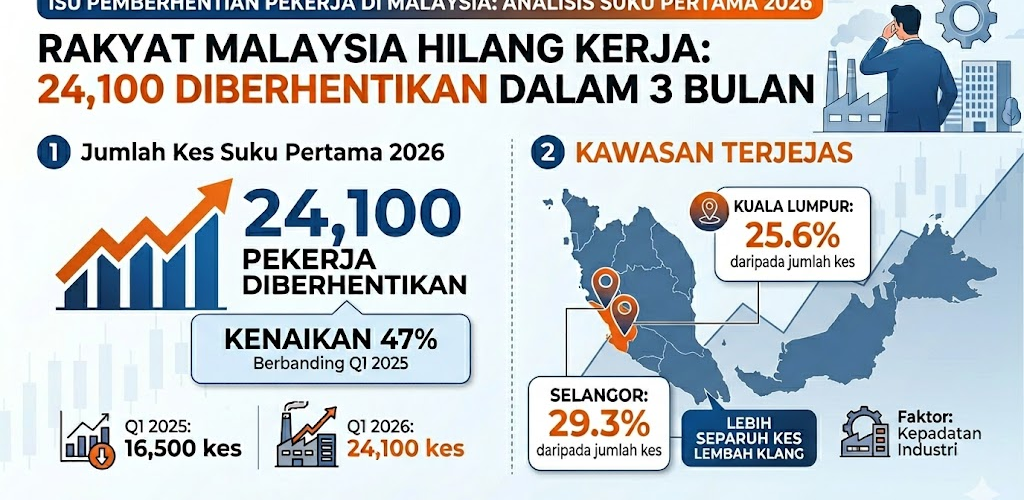
The issue of Malaysians losing their jobs came back into focus when the number of laid off workers increased significantly in the first quarter of 2026.
This situation is not just a temporary issue, but is closely related to changes in the global and domestic economic structure.
According to the latest report from the Social Security Organization (SOCSO) analyzed by Hong Leong Investment Bank (HLIB), about 24,100 workers in Malaysia were laid off in the first quarter of 2026 (Jan-March), an increase of 47% compared to about 16,500 cases in the same period in 2025.
For ordinary people, this gives immediate financial pressure such as house installments or family needs, especially in big cities.
Summary of Malaysians Out of Work
- A total of 24,100 workers were laid off between January and March 2026.
- This number increased by 47% compared to the previous year (Jan-March 2025: 16,500 cases).
- More than half of the cases of layoffs are concentrated in Selangor (29.3%) and Kuala Lumpur (25.6%) due to the density of industrial activity in the Klang Valley.

What is the issue of Malaysians losing their jobs?
Malaysians out of work increased mainly due to a surge in layoffs in the first quarter of 2026, with 24,100 workers laid off.
The main problem comes from the weakest manufacturing sector as it is exposed to global trade tensions, weak export demand and company restructuring.
Other sectors such as wholesale and retail trade as well as logistics and communications were also affected, showing that the economic pressure is widespread in more than just one industry.
Although the unemployment statistics jumped 47% to 24,100 cases in the first quarter of 2026, the national unemployment rate has remained stable at 2.9% for the past few months because the Malaysian labor market is experiencing “employee rotation; that is, workers who are laid off from one sector quickly move to another sector that is still growing.
This means that not all workers who lose their jobs remain unemployed.
Many managed to find new jobs, causing the overall unemployment rate not to rise drastically.
Job vacancies will increase to around 107,000 in March 2026, mainly in the service sector (such as hospitality, finance, and technology) and construction.
Latest Statistics
Is it true that Malaysians are losing their jobs?
Yes, job loss statistics in Malaysia did increase in the first quarter of 2026.
This is based on the latest data from the Social Security Organization (SOCSO) analyzed by Hong Leong Investment Bank (HLIB).
In January-March 2026, as many as 24,100 workers were laid off. This number increased by 47% compared to the previous year (Jan-March 2025: 16,500 cases).
- January- 10,700 cases
- February – 7,500 cases
- Mac – 5,900 kes
Areas Most Affected:
- Selangor: 29.3% of March cases (main industrial hub).
- Kuala Lumpur: 25.6% of March cases (more than half of cases in the Klang Valley).
- Others: Penang (E&E sector) and Johor (trade with Singapore).
Although this figure seems alarming, the national unemployment rate still remains around 2.9%, showing that the labor market is still stable overall.
What Are the Main Causes of Layoffs in Malaysia?
The issue of layoffs in Malaysia in 2026 is driven by several critical interrelated factors.
Although the labor market as a whole appears to be stable, certain sectors face major challenges that force employers to take drastic measures.
The following are among the factors that are the main causes of layoffs in Malaysia:
1. Global Demand Weakness (Manufacturing Sector)
The manufacturing sector, especially export-oriented industries such as electrical and electronics (E&E), is the most affected.
- Reason: International trade tensions and a slowdown in the world economy reduced orders from overseas.
- Effects: As production decreases, companies are forced to downsize the workforce to offset costs.
2. Automation and Digital Transformation (AI)
Technology is now no longer an option, but a necessity that replaces human labor in routine tasks.
- Reason: The use of Artificial Intelligence (AI) and automated machines in office tasks and factory operations.
- Effects: There is an issue “redundancy” or redundancies where old positions are abolished because the process can be done faster and cheaper by technology.
3. Company Restructuring & Merger
Many organizations undertake massive structural changes to remain relevant in a competitive market.
- Reason: A merger between two companies (mergers) or acquisitions often create duplication of positions.
- Effects: Units or departments that are no longer profitable will be closed, while redundant positions will be reduced through VSS (Voluntary Separation) or MSS (Joint Separation) schemes.
4. Skills Mismatch
There is a huge gap between what workers know and what the industry needs now.
- Reason: The industry is now looking for experts in green technology, data analytics, and advanced engineering.
- Effects: Workers who do not improve their skills (upskilling) are at high risk of being laid off because companies are more likely to hire new talent with future skills.
5. Operating Costs and Employer Financial Pressure
The increase in the cost of living is not only felt by the people, but also by business owners.
- Reason: Rising raw material prices, utility costs, and higher minimum wage adjustments put pressure on the company’s cash flow.
- Effects: SMEs (Small and Medium Enterprises) that are unable to cover high operating costs are forced to close their businesses or fire employees for “survival”.
What Should You Do If You Are Fired?
If you are fired, stay calm and follow the steps below to protect your rights according to the Employment Act 1955 and SOCSO/JTK guidelines.
Step 1: Get Official Documents
- Ask for written termination letter (reason, work deadline, compensation amount).
- Check last payslip, annual leave balance, and contract for notice period.
- Final payment (salary + leave + compensation) must be in 7 days. If it is late, make a JTK complaint.
Step 2: Apply/Register for SOCSO Assistance (Within 60 days)
Step 3: Calculate & Claim Employer’s Compensation
Payment of severance benefits shall be in accordance with the service contract, but shall not be less than the rate set under the Employment (Termination and Temporary Retirement Benefits) Regulations 1980, Employment Act 1955 namely:-
- 10 days’ salary for each year of service if the employee has served less than 2 years;
- 15 days’ salary for each year of service if the employee has served for 2 years but less than 5 years; or
- 20 days’ salary for each year of service if the employee has served 5 years or more and is calculated pro-rata over the odd period of a year, according to the nearest even month.
Employees are entitled to written details of the total amount of termination benefits and how the calculation is made. Termination benefits must be paid no later than 7 days from the date the employee is terminated.
Use the JTK calculator (jtksm.mohr.gov.my) to do the calculations.
| Term of Service | Termination Benefit (Salary |
|---|---|
| Less than 2 years | 10 days salary per year |
| 2-5 years | 15 days salary per year |
| More than 5 years | 20 days salary per year |
Step 4: If Suspected Unfair Dismissal – JPP Complaint
If you feel you have been dismissed without reasonable cause (for example: there is no misconduct investigation or redundancy does not follow the LIFO “Last In First Out” rule), you can make an official complaint to the Industrial Relations Department (JPP) to claim your rights according to the Industrial Relations Act 1967 (Section 20).
Step 5: Stabilize Finances & Find a Job
- Find a Job: LinkedIn/JobStreet updates, MyFutureJobs register and so on.
- Upskilling: Join the SOCSO/HRD Corp free course
SOCSO Employment Insurance Scheme (SIP) Assistance – CAREER PROTECTION
The Employment Insurance System (SIP), now known through the LINDUNG KERJAYA initiative, is a social security scheme established under the Employment Insurance System Act 2017 (Act 800) and administered by the Social Security Organization (PERKSO).”
The scheme aims to assist workers who have lost their jobs by providing temporary financial assistance as well as new job placement support.
Among the eligibility consequences of losing a job:
- Regular layoffs
- VSS/MSS (Voluntary Separation Scheme)
- Workplace closures due to natural disasters
- Closure of business or closure of operations
- Constructive disposal of work
Among examples of inappropriate job loss:
- Termination due to employee misconduct
- Voluntary resignation
- Compulsory retirement
Among the benefits of SIP:
- Elaun Looking for a Job (EMP): Eligible beneficiaries will receive an allowance for 3-6 months
- Reduced Income Allowance (EPB):Income replacement for those who have more than one employer and have lost one or more jobs
- Early Reemployment Allowance (EBSA): 25% incentive for employees who return to work early during the EMP period
- Training Allowance (EL): daily rate of RM10-20 for retraining
- Be Latihan (FL): Training fee financing paid directly to the training provider at a maximum rate of up to RM4,000
More Information
For the latest information and more information about job loss, please refer to:
- Department of Statistics, Malaysia
- SOCSO – Employment Insurance (CAREER PROTECTION)
- Corporate Relations Department (JPP) – Unfair Dismissal Complaint
- Department of Labor (JTK) – Compensation & Salaries
Frequently Asked Questions of Malaysians Losing Their Jobs
A total of 24,100 workers were laid off Jan-March 2026 (Jan: 10,700, Feb: 7,500, March: 5,900).
No, remained stable 2.9% since 4 months. Job vacancies rise to 107,000 March 2026, meaning many will find new jobs in service/construction.
Sector: Manufacturing (electronics/semiconductor), wholesale trade, logistics
States: Selangor (29.3%), Kuala Lumpur (25.6%) – more than 50% of cases in the Klang Valley
Claims must be made within 60 days of your last date of employment. If you are late, your application may be rejected.
Nope. SOCSO SIP benefits are only given to those who lose their jobs beyond their control (such as layoffs, company closures, or VSS/MSS). Resigning on your own does not qualify you for this assistance.
– Termination Letter.
– Copy of Identification Card (IC).
– Pay slips (last 3-6 months).
– Active bank statement for aid crediting.
The government has strengthened social protection for gig economy workers. Although not the same as permanent employees, the voluntary contribution scheme under SKSPS SOCSO provides protection in the event of an accident or disability while working.
Yes, you are still eligible. Even if the company goes bankrupt or goes out of business, you can claim compensation from the employer (severance pay + termination benefits) AND SOCSO assistance. Company bankruptcy/factory closure is the main qualifying reason for the Employment Insurance System (SIP).
PakarPBN
A Private Blog Network (PBN) is a collection of websites that are controlled by a single individual or organization and used primarily to build backlinks to a “money site” in order to influence its ranking in search engines such as Google. The core idea behind a PBN is based on the importance of backlinks in Google’s ranking algorithm. Since Google views backlinks as signals of authority and trust, some website owners attempt to artificially create these signals through a controlled network of sites.
In a typical PBN setup, the owner acquires expired or aged domains that already have existing authority, backlinks, and history. These domains are rebuilt with new content and hosted separately, often using different IP addresses, hosting providers, themes, and ownership details to make them appear unrelated. Within the content published on these sites, links are strategically placed that point to the main website the owner wants to rank higher. By doing this, the owner attempts to pass link equity (also known as “link juice”) from the PBN sites to the target website.
The purpose of a PBN is to give the impression that the target website is naturally earning links from multiple independent sources. If done effectively, this can temporarily improve keyword rankings, increase organic visibility, and drive more traffic from search results.